This is the first post in a series about plumbing my toilet to flush with harvested rainwater. This post is about how wanting a mains back-up will necessitate complying with strict legislation, including ensuring the potable supply is air-gapped. Read on to learn what on earth that means...
My job is all about managing surface water (i.e. rainwater) better. Done properly, surface water management builds resilience to drought and heavy rainfall, protects the environment, reduces water treatment costs, adds system redundancy etc.
Surface water management
When we think about managing surface water we choose our interventions based on a priority pyramid:
Our best possible option is to reuse surface water: reducing water demand whilst also eliminating the challenge of getting rid of the surface water. This isn't environmentally perfect, ecosystems and aquifers need rainwater too, but as our reuse opportunity is pretty limited there'll still be loads to go around.
Disconnection is all about using the natural environment to handle surface water rather than our drainage networks. Allowing runoff to soak into the ground allows ecosystems to take it up, reducing drought impacts, maintaining river flow rates, and preventing us from having to deal with it downstream. Evaporation also cools the surrounding air, which is increasingly important in our warming world.
Finally, if we have no other option but to use drainage networks to manage our surface water, then at least we can attenuate the rate at which it enters them. This is just slowing runoff down so that it doesn't enter drains all at once and overwhelm them, but does so slowly and gradually, spread out over time so that our networks don't surcharge.
Reuse
Disconnection is relatively easy - just shove your downpipe into a soakaway and let nature do the rest. Attenuation isn't all that difficult either, you just put a water-butt in this system which slowly drains into your lawn. The real challenge, and the surface water management holy grail, is how you engineer domestic water systems to allow for reuse.
The easy answer is you store it in a water-butt and using it in the garden, or to wash the car. That's great, but the average UK householder with a water-butt uses <45L of water from it per month, so this isn't a feasible solution for the quantity of surface water we have to deal with. We need a way to take this water and use it domestically, and the perfect use case is...
Flushing toilets
Flushing toilets feels like the biggest waste of potable water in our homes. It goes straight into a dirty toilet bowl and then down the drain - it's the perfect use case for relatively clean, but not potable, rainwater. So here are some specifications for a system that allows us to flush our loo with rainwater:
- refill the cistern with rainwater when available;
- when no rainwater is available, refill with potable water;
- allow the toilet to be flushed even when there's a power cut;
- fail "safe" so that I don't flood my house or start a fire;
- easily disable the system in the event of a failure; and perhaps most importantly
- prevent backflow of rainwater into the potable water system.
Why do we need to worry about backflow? Well, the easiest way to meet our specifications above is by using an "indirect system". An indirect system uses rainwater to fill a header tank, usually in the loft, which then supplies your household appliances.
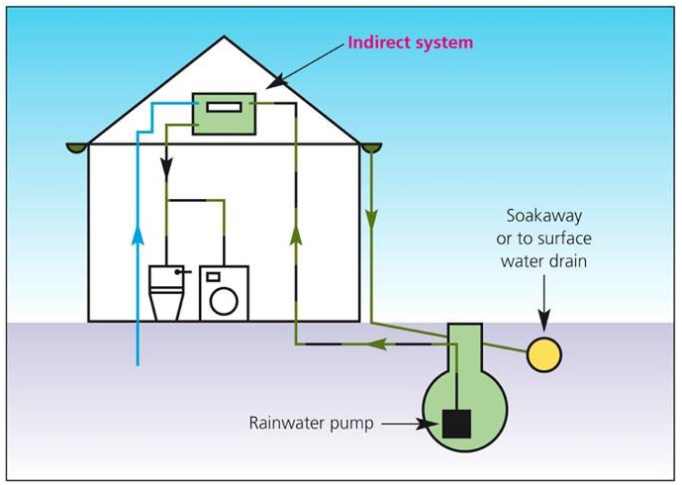
This has a couple of benefits.
- Firstly using a header tank means that in the event of a power-cut, the water stored in that header tank will be used, so we'll still have water, which wouldn't be the case if we were pumping our water directly from the rainwater harvesting system.
- Secondly, we can install a potable water back-up in our header tank, so that if there is not enough rainwater to supply our appliances then our mains water will kick in and fill the tank. As our mains water is gravity fed, this will work in a power-cut too!
The downside to using a header tank (or any potable water back-up) is that we need to prevent our dirty rainwater from entering the potable water distribution system.
I'm afraid I'm now going to horribly distract myself by talking about water regulation. This regulation helps prevent backflow from polluting potable water sources, and tells us what backflow prevention techniques we need to employ, but it wasn't written with rainwater harvesting in mind, which makes actually applying it slightly tricky. Allow me to explain...
Water regulations
We tend to think that an Englishman’s house is his castle (and have since ~1505!) but in our modern world we don't have quite as much freedom as we might think...
As we share our water distribution networks with our friends and neighbours we have a responsibility, and a legal duty, not to poison it for anyone else! This is established in the "Water Supply (Water Fittings) Regulations (1999) (revised)", which are surprisingly readable, and unsurprisingly somewhat unclear.
Schedule 1: Fluid categories
The first thing we need to think about is what "fluid category" our rainwater is. This determines what measures are sufficient for preventing it from entering the water distribution network - scarier fluids require more stringent backflow prevention methods.
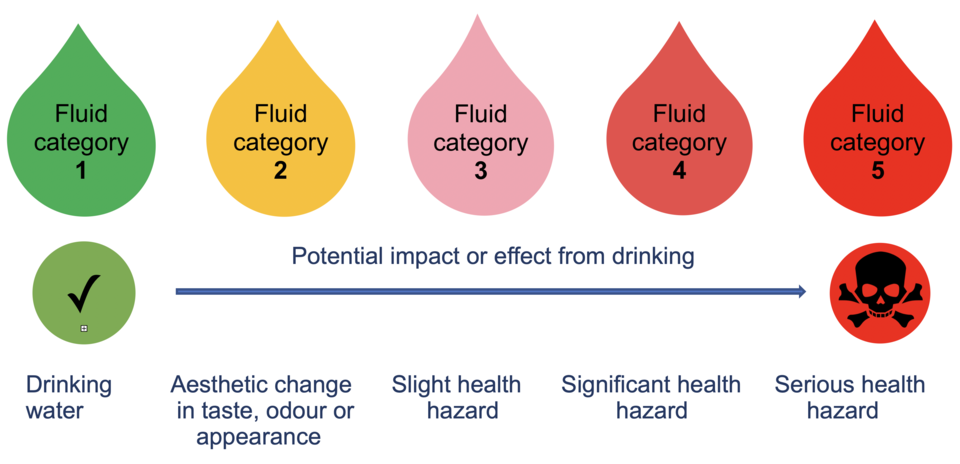
Now as far as I'm aware there's not a hard and fast way of determining what category a specific fluid is!
Most people seem to treat rainwater as category 5 (super scary death fluid), along with sewage, liquid mercury, and radioactive waste. This is because it may contain pathogens, which I understand to mean any organism that can produce disease. Confusingly, category 4 fluids include fluids which may contain "environmental organisms of potential health significance". In my eyes there's not a meaningful difference between these two definitions. Category 4 fluids also include any fluid that represents a significant health risk due to concentration of chemical, carcinogenic substances or pesticides (including insecticides an herbicides), and I'd consider roof harvested rainwater to be more at this level of risk.
All that being said, it doesn't actually matter what I think, because I'm not the one that gets to decide...
Regulation 5: Notification
Regulation 5 means that we need to let our water provider know if we intend to make certain changes to our plumbing so that they can check it's all safe and give us the go ahead - not doing so is an offence! And if they think it's a category 5 fluid then I'll have to treat it like one whether I think they're right or not.
So when do we need to notify our "water undertaker" and get their consent? Well, there are a few cases which we might consider apply to us:
The installation of [...] (f) a water treatment unit which produces a waste water discharge or which requires the use of water for regeneration or cleaning; (g) a reduced pressure zone valve assembly or other mechanical device for protection against a fluid which is in fluid category 4 or 5;
This might initially look like it catches us, but it doesn't. We're not treating any water, so (f) doesn't apply, and we're going to rely on a non-mechanical device for protection against our category 4 fluid anyway, because it's both cheaper and easier. What else might apply to us?
A material change of use of any premises.
I would argue that re-plumbing your toilet to flush with rainwater isn't a material change of use of your house, but Regulation 1 complicates matters by saying:
“material change of use" means a change in [...] the circumstances in which, premises are used, such that after that change the premises are used (where previously they were not so used) [...] for the purposes of the storage or use of substances which if mixed with water result in a fluid which is classified as either fluid category 4 or 5;
Now this is a challenge. I am using my house for the purposes of storing rainwater, which is probably a category 4 or 5 fluid, but I was doing so previously when I installed my water-butts. Before then I bought 5L of paint for my fence, which is almost certainly a category 4 or 5 fluid too - was I supposed to notify South West Water when I bought it? Surely not.
The Regulator
If this wasn't complicated enough, the legislation leaves some decisions up to "The Regulator", who in England is "the Secretary of State" (which, confusingly, actually means any of them). The Regulator has approved three specifications as being suitable for demonstrating compliance with the legislation, which astonishingly seem to only currently be available on the website of a private limited company (this will change in May 2027).
That private limited company produces some helpful guidance that tells us that we do indeed need to tell our water company if we want to install an "alternative water system". It also tells us that "alternative water systems" are category 5. This guidance itself isn't approved by the regulator, but everyone treats it like it has been, so I'd probably better begrudgingly follow suit.
Air gaps
The actual approved specification that's relevant to us is "the Regulators' Specification for Backflow", as it tells us what type of backflow prevention we need to employ for different use-cases. We're essentially allowed either AA, AB, or AD:
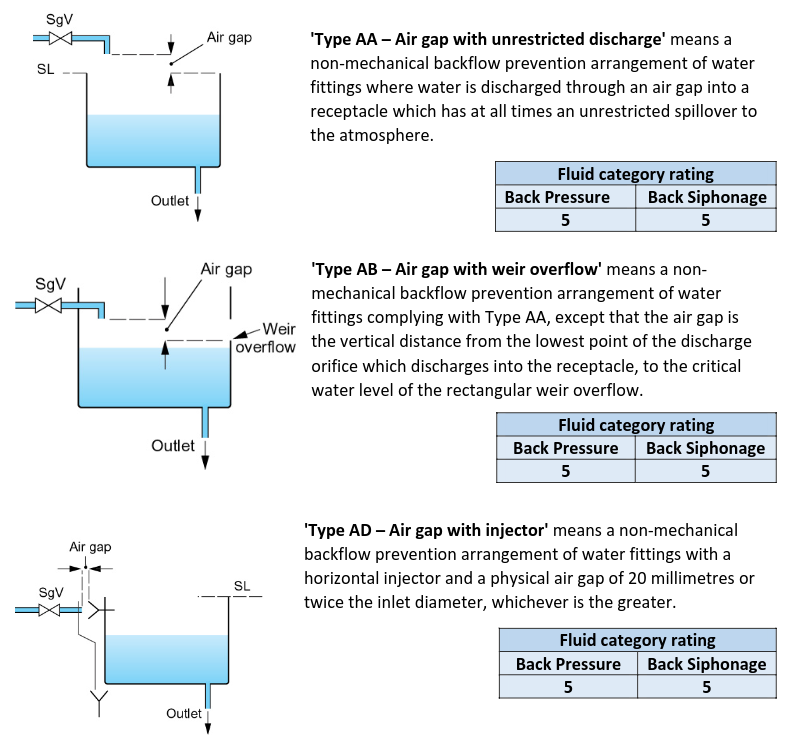
The cheapest and easiest of this to employ will be the AA air gap, which just means we need the water feed to hover above our balancing tank so that if it overflows no water will make its way back into the supply.
Labelling and identification
Air gaps aren't our only constraint - we also have to label our pipes in accordance with BS 1710:2014.
There's some helpful guidance from the same private limited above which tells us what colours to use, or you could shell out £££s to buy a PDF of the standards from the BSI, but whatever you do don't download a PDF of them from Anna's Archive or something because that would be illegal.
Anyway, we need:

Which indicates water (green) from somewhere other than the public water supply (flint grey) that is non-potable (black). It's also labelled as "rainwater" using a text-based label, as the standards require supplementary information to make it easy for those who don't understand the colour codes to work out what's in the pipes.
Where does that leave us?
You might think we've not achieved anything in this rambling blog post, but we have! We've worked out that:
- You need to tell your water company if you're flushing your toilet with rainwater
- A header tank allows you to be resilient to power cuts and have a mains back-up, but you'll need an air-gap and other compliance measures
Next time I'll share the designs for my system so that we can explore some of our other challenges.