This is the third post in a series about plumbing my toilet to flush with harvested rainwater (here are the first and the second). This one is a bit of a deep-dive into how you choose the ideal water-butt for a rainwater harvesting system.
Practical considerations
Now I am very lucky as I already have a perfectly suitable water-butt on the downpipe at the front of my garage. To reduce my environmental impact as much as possible I'm going to use the one I've already got, but if I had to buy one specifically for this purpose I'd be looking for one that is:
- Large: for maximum rainwater storage;
- Tall: for maximum hydraulic head to minimise the effort that the pump has to put in to raise water to the loft tank;
- Plain: textured "wood effect" faces can make it harder to add bulkheads if you need to add an outlet, as the ridges can prevent them from sealing property;
- Attractive: or at least, not unattractive; and
- Cleanable: having a threaded outlet at the very bottom of the tank makes it much easier to clean out the butt-sludge (there go all my readers with Safe Search on!) that otherwise can build up and clog up your pump or discolour your water.
I quite like the water-butts that Graf / Garantia make - they tend to be high volume and reasonably practical. That being said they are intended for the European market, so the taps provided with them are much bigger than you see on the UK market, which makes it quite hard to find compatible hoses. The threads are 3/4" BSP female though, which suits us fine. Here are some examples of theirs:
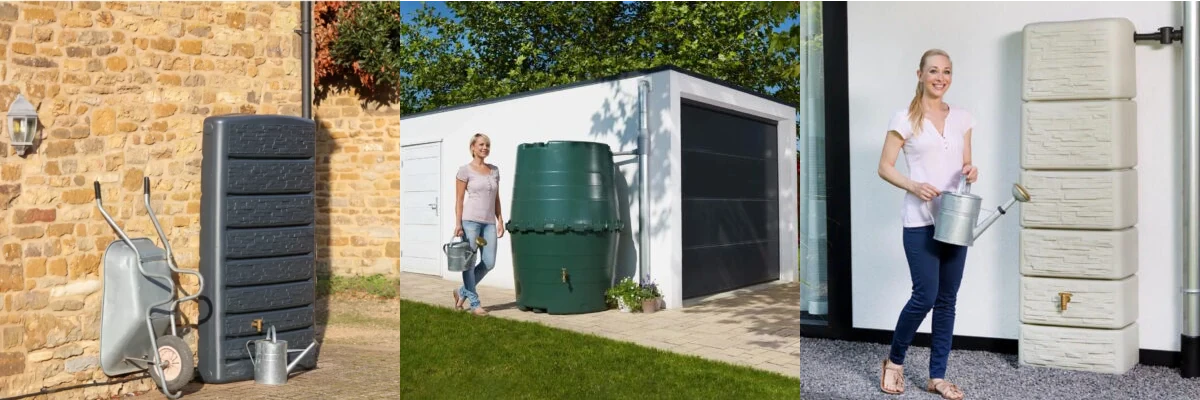
From left to right the above water-butts are \(400 \text{l}\), \(1,300 \text{l}\) , and \(500 \text{l}\). Which brings me onto...
Choosing the volume
Obviously the bigger the water-butt the less likely it is to run out, but at some point your water-butt will be so large that it'll be very unlikely to ever fill, at which point that extra volume is just an eyesore and not actually giving you any meaningful functionality. So how do we work out where this point is?
Empirical methods
BS 8515 (Rainwater harvesting systems: Code of practice) has an easy and boring method called the "intermediate approach" which says:
storage capacity should be [...] the lesser of \(5 \%\) of the annual rainwater yield or \(5 \%\) of the annual non-potable water demand
How much water runs off your roof?
The amount of water that ends up in your water butt when it rains is:
\[ \text{runoff volume} = \text{catchment area} \times \text{rainfall depth} \times (1 - \text{loss factor})\]
This is heavily simplified - for example rain doesn't fall down vertically, it is carried by the wind, so a pitched roof facing the prevailing wind will capture a larger volume of rainfall than one facing away from it, and downpipe diverters become less efficient at higher downpipe discharge rates - but for our purposes it'll do.
We'll assume that you have an impermeable roof, not a grass roof, and that your guttering isn't horribly leaky, so we'll say that \(\text{loss factor} = 5 \%\). The downpipe I'm working with is connected to about a \(12 \text{m}^{2}\) (plan) roof, so our equation becomes:
\[ \text{runoff volume} = 12 \text{m}^{2} \times \text{rainfall depth} \times 0.95\]
The "intermediate approach" wanted the annual yield, which you can either look up using the maps in the above standard (which you really really musn't download from Anna's Archive rather than spend £322 on), or guesstimate using Met Office long term climate averages. For my location the annual rainfall depth is suspiciously close to 1000mm, giving us:
\[ \text{runoff volume} = 12 \text{m}^{2} \times 1,000 \text{mm} \times 0.95 = 11,400 \text{l}\]
How much water will I need?
The Energy Saving Trust estimates that flushing the toilet accounts for ~ \(22 \%\) of an individuals water consumption, or a little under \(32 \text{l}\) per day, or \(11,680 \text{l}\) annually.
This is an astonishingly similar figure to how much rain will run off our roof annually, but we'll behave ourselves and choose the smallest (the annual rainwater yield) and multiply it by \(5\%\) to get a suggested storage volume of \(570 \text{l}\).
The problem with this approach is that the suggested volume doesn't change when I remember that I'm married, and that my wife has a propensity to use the toilet too sometimes. I also don't like empirical methods because 🤮.
Quantitative methods
There's a nice open-access paper, "Optimal sizing of rainwater harvesting systems for domestic water usages: A systematic literature review, Semaan et al. - Resources, Conservation & Recycling: X - 2020", which gives loads of approaches for how to work out the perfect size for your water-butt. The most popular is a very simple simulation, introduced by Jenkins and Pearson in 1978, referred to as the mass-balance method.
The idea is that, every day (or whatever timestep) some rainfall enters the system and some water leaves the system (is used). As long as you have a nice long rainfall timeseries for the location you're interested in then you can just step through and calculate this on a day by day basis to work out how your water-butt would have performed. If you take a metric like "number of days that the water-butt wasn't empty" and plot it against different water-butt volumes, you should see the diminishing return of volume increases.
As luck would have it the EA make it very easy to download daily rainfall records from their gauges using their Hydrology Data Explorer, which is what I did for my nearest gauge.
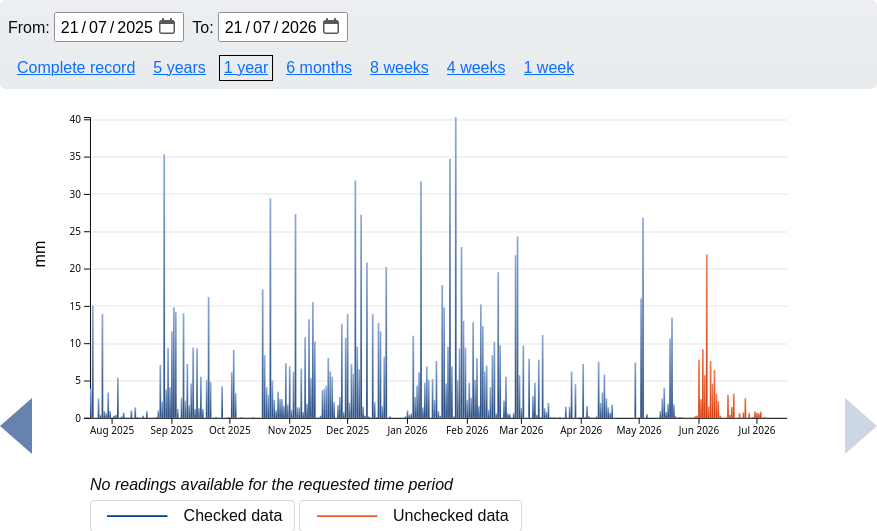
It's then relatively simple to cobble together a python script to iterate over each day and adjust the volume in the tank according to the rainfall landing on the roof and the amount used in the house. You can pass it a load of different tank volumes and usage amounts and see when the added volume stops being a good return on investment.
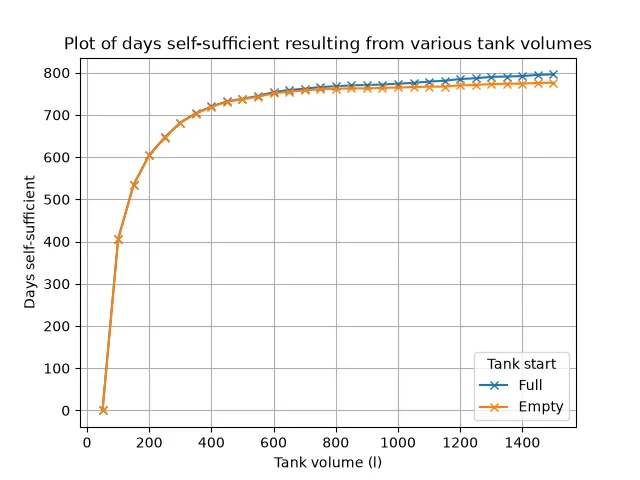
This was driven from 1887 days (over 5 years) of rainfall data, and ups the demand figure to \(64 \text{l}\) per day (which is pessimistic as we're rarely both in the house). It suggests that with a \(570 \text{l}\) tank we'd have been self-sufficient about \(40 \%\) of the time. You can see that after about \(600 \text{l}\) there's very few additional days of self-sufficient flushing added by increasing the volume of your tank.
If it's just me in the house the picture looks like this:
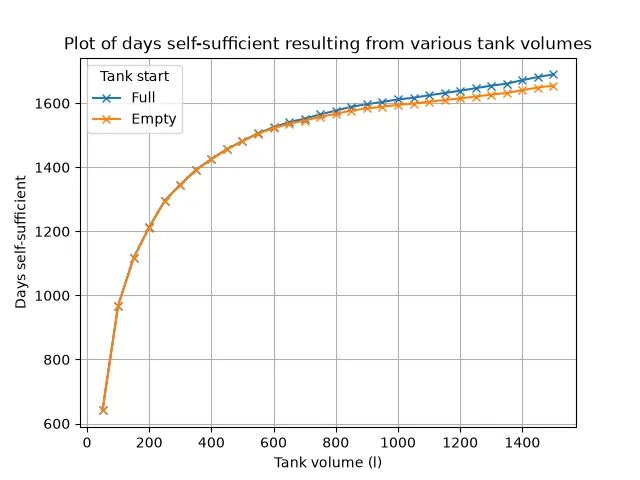
This is probably a more realistic usage, and the tail-off of benefit isn't quite as sharp, but we'd still be very well served by the tank size suggested by the empirical method! Maybe I shouldn't be so disgusted by it after all!
The two colours on the plot show whether the simulation starts with a full or empty tank, and it's interesting how big a difference that makes for bigger tank volumes - that probably tells us about an early dry spell in our rainfall data or something.
What next?
So we've worked out what our system needs to do to be compliant, designed it, and decided we want a \(~500 - 600 \text{l}\) water-butt, but we still need to work out what we need to buy to build it, and how much that will cost. Tune in next time, and we'll do just that!